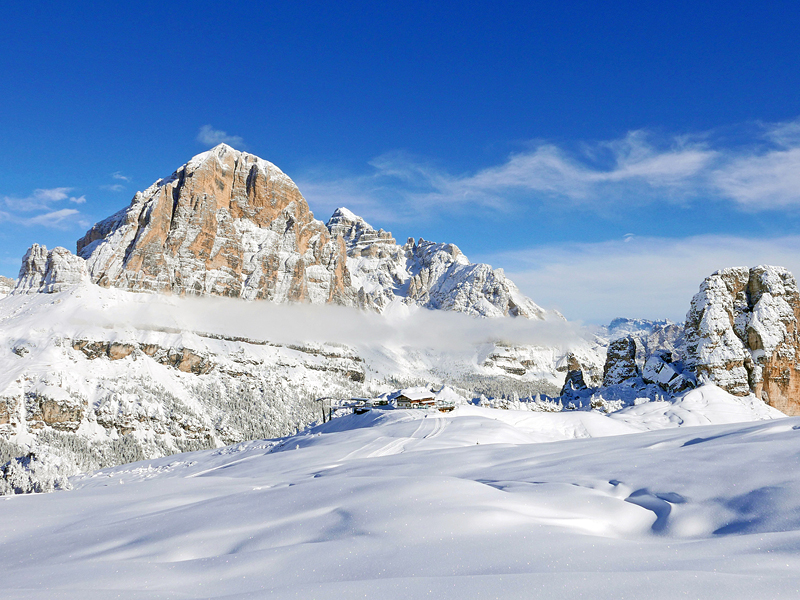
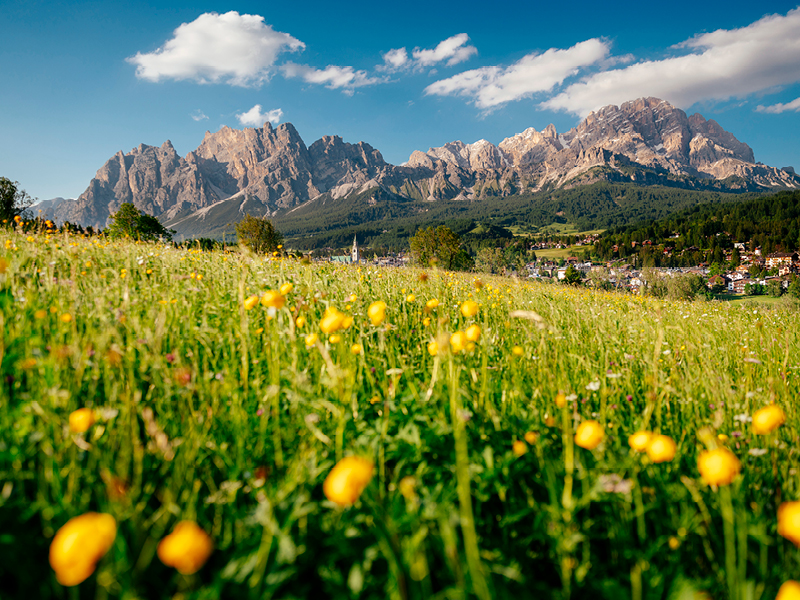
Man has left a number of ancient marks in the Cinque Torri-Averau area since the early traces of seasonal settlements of shepherds and woodcutters and the alterations of the environment that followed.
An unpublished collection of 47th vintage postcards of Cortina and surroundings, from the 20's to the 50's .
Chapter 20 - 1956 Winter Olympics
Winter Olympics should have taken place in Cortina in 1944, as it had been arranged by the International Olympic Committee, as early as in 1930. Yet, in 1944 the war was furiously enraging all over the planet and Italy, invaded by the Reich army of which it was formally an ally was struggling on the brink of death.
When peace was restored, the issue was taken up again by the Town council in 1947, mayor Angelo Ghedina Biajo. The proposal however did not obtain a unanimous consent, despite the strong pressure by the local press and the Belluno prefecture. The following year in the meanwhile Oslo had been awarded the 1952 edition the Town council discussed the matter over again without finding a common line. Even a referendum was suggested to ask for the opinion of the population. Eventually, the impasse was unblocked; the formal promise by the Coni (Italian Olympic Committee), which would undertake all the expenses, arrived from Rome.
Having been assured that the expensive facilities would be paid for by the government and not by the Municipality, the last Town Council of 1948 (on December 30th) unanimously agreed to formally ask that the 1956 edition be awarded to Cortina. Following the decision of 29 years before, the IOC agreed to the request in the session of 4th April, 1949. The first to learn about the thrilling piece of news were the students of the school, informed by an excited mayor. In the evening, the radio gave the announcement to the population.
At that time the Municipality of Cortina d’Ampezzo counted 5,450 inhabitants.
Awaiting and preparing the event
Huge problems were to be faced. In agreement with the government authorities, a special body was created to coordinate the preparatory stages and Otto Menardi was appointed as chairperson. Priority was given to sports facilities: ice stadium, ski-jump, bobsleigh track, uphill lifts and ski runs for the competitions. For speed skating competitions, the lake of Misurina, a few kilometres far, was chosen. At the same time, the problem of athletes and tourists coming to Cortina was being dealt with. Access was mainly expected along National road 51 of Alemagna. The glorious road, which had been built by the Austrians between 1825 and 1830 was renovated to improve the traffic flow. National road 48 of the Dolomites, which diagonally cut the ridges to connect Cortina to Cordevole, Badia, Gardena, and Fassa valleys, and farther on to Bolzano and Trento, was not taken into consideration. Passes were often closed for too much snow in wintertime, sometimes even for months, the avalanche hazard was high, and it was still unpaved. The most attention was given to the narrow-gauge railway, which had been connecting Cortina since the post-war years, to the two terminus of the Italian Railways, Calalzo to the South and Dobbiaco to the north. In 1927 it had been electrified thanks to the all important contributions of the municipalities concerned, Cortina in the very first place. It was suggested to seize this opportunity to widen the railway to standard gauge in order to avoid this minor (60km only) solution of continuity in the Italian and European railway system. This initiative was never realized. However, the small railway underwent a few ameliorations, totalling 1 billiard lire. Some bends were made straight, a few kilometres of tracks were reinforced, some level crossings were signalled by traffic lights and two modern electric trains and three new carriages were purchased. Mr Gronchi, President of the Italian Republic, reached Cortina for the official opening of the Games by one of these new carriages from Calalzo. The town road-network was improved by creating a by-pass to connect the existing roads with two new ones. A ramp - today's via Baron Franchetti - mounted up the bank of the Bigontina stream, went under the railway bridge and completed the ring to the east. To the west, a new road where heavy traffic was to be diverted- today's via Olimpia - was created parallel to prestigious Corso Italia. A connecting road was opened between these two arteries: via Bruno Apollonio. Where once there was the small Pontegèl square, between the hotel boulevard and the railway station, the new management centre was realized around a new multi-purpose building. E. Gellner, an outstanding architect, devoted one building to house a number of offices: post and telecommunication offices, the magistrates' court, land register office, police station, tax office, exhibition rooms. Around the building , hotels, blocks of luxury flats, night clubs , art galleries, crafts shops , shops, banks were erected. Accommodation was taken into account too. Almost all the hotels had suffered from the war. From 1941 through 1946, they had been occupied by hospital structures; Italian structures at first , then German and eventually American ones, to give hospitality to wounded or ill soldiers coming from the front. Even private houses had been used for the same purpose; the most beautiful ones had been confiscated and used as military headquarters. Readily enough, the Government issued a series of legislative measures to grant loans to hotel structures in order to stimulate the renovation and modernization of hotels and meublés, build refreshment services, and improve accommodation. A few hotels, with well-organized management structures - i.e. the big hotels - were able to take advantage from these measures. The majority of the hotels instead, which were unable to face bureaucratic difficulties, mainly for the amount of guarantees required, had to turn to ordinary credit, thus getting into debts exceeding their economic possibilities. However, general enthusiasm was great.