Faloria - Cristallo - Mietres summer
Walks
Map of paths
Vie Ferrate
Mountain huts
Mountain bike
Ideas
Gallery

Paul Grohmann
Like many mountains atround Cortina, these too were first climbed by Paul Grohmann: in 1864 Sorapis, a year later Cristallo.
Home Skipass
If the Cinque Torri are the abandoned camp of defeated giants, then the Sorapis is the mountain of their glory.

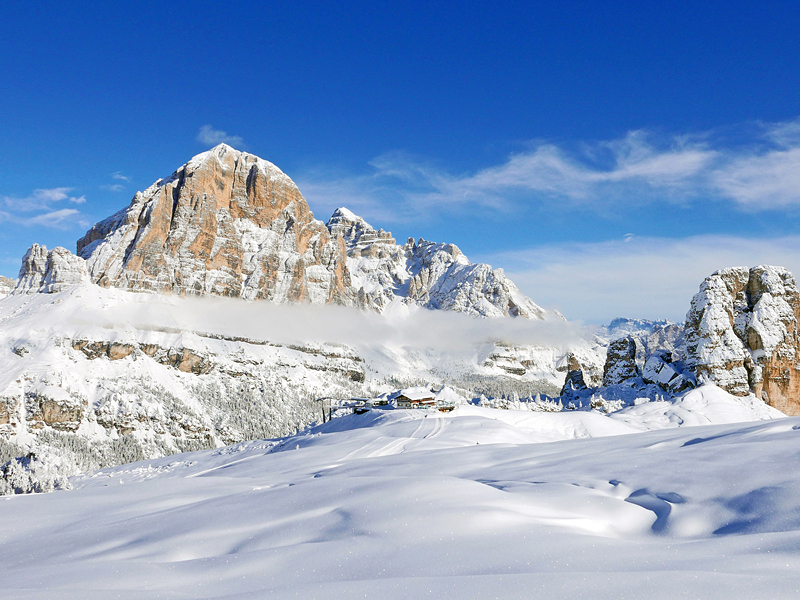
Today, just like then, its towers rise steeply into the skies and enormous barbicans defend them against those who try to attack the base and flanks. Between Valbona and the river Boite, between Cristallo and Antelao these giants constructed the largest castle in the world.

Inspired architects drew, with powerful lines, the rock faces and bastions, the terraces and loop-holes. Thousands and thousands of slaves placed stone upon stone, and although these rocks are coloured red with their blood, the castle is large, solid, sturdy, perfect.

To the south and west, where the proximity to Antelao and Pelmo posed the greatest danger, the defence towers are complex and daring, the walls smoother and the loop-holes closer, located one next to the other.

The Croda Marcora on the banks of the river Boite is an immense bulwark over 2000m high, from which a gallery at half-height, the so-called cengia del Banco, leads the sentry-men from the north to the finishing spurs in the south.

With powerful strokes a giant artist has frozen this wall into a sphinx, hundreds of meters high; mute and cold it eternally looks towards Pelmo. The mountains Caccia Grande, Croda del Banco and the Tre Sorelle to the west, Foppa di Mattia, Punta Nera, Croda Rotta, Selletta and the Cesta to the east form an immense arc around the Magnifico, which looks nostalgically onto the green valley dell'Ansiei, for above 3000m he can never take off his ermine coat. A 2700m tripod, the Zurlon glows in front of the throne of the King of the Mountains. This grand amphitheatre looks out onto Misurina, and deep within it the giants created three reservoirs to guarantee their defence, even if the assault were to last many years: the glaciers to the west, center and east. And to defend the south a daring master mason placed a thin glacier on the Foppa di Mattia.

The first shepherds who walked up into the Ansiei valley watched their flock spread out towards the cascata del Pis, on the white mountain that extended, immense, above their heads. Since they could think of no other name to describe this immense castle, they called it “sora el”, or “above the”, Pis. Hence the name Sorapis. None of them dared climb up to the summit. In winter enormous avalanches tore down the hillsides from Fedaraveccia to Ponte delle Acque Rosse, and in summer, while the Magnifico sparkled, red waterfalls precipitated down into the valley.

In 1864 the Viennese Paolo Grohmann came to Cortina for the first time. He spent long days walking around Sorapis, studying its defence, examining the weakest towers. Finally, on 2 September together with Francesco Lacedelli and A. Dimai from Cortina he made his bid for the summit, but returned defeated. He did not give up though, and ten days later he returned, only to be pushed back down into the valley once more by the giants. On 16 September the valiant three crossed Vallone del Banco and Pian della Foppa, climbing a diagonal ramp through the large Foppa di Mattia face, to reach the summit. A slice of wholemeal bread and a piece of lard were their celebration meal. And then Grohmann, in front of all the other mountains and close to the sky, named Francesco Lacedelli the first Ampezzo Mountain Guide.

But by now it was late, very late. They had to get off the mountain. The ascent route would have been too long and the night might have caught the three unaware, from behind. Grohmann dared once more and crossed the mountain, heading directly for Tondi di Rusecco. The first lights had already been turned on in the small houses above S. Vito, but the battle was not yet over. A steep drop stopped the three mountaineers in their path. Grohmann untied the rope, looped it around a rock and throew the other end it down the face. And abseiled down this – the first ever in the Dolomites.

Late at night the three reached Cortina, and the pioneer Paolo Grohmann recorded in his diary one name: Sorapis 3205m. For ten long years no one dared follow in their footsteps. But then the passion for the mountains gains upper hand and many climbed to the top of Sorapis, most along Grohmann’s chosen line of descent. The Italian De Falkner with Costantini on 1 September '92, while F. Muller and S. von Watterhausen with Dibona, Dimai and Pompanin on 15 September opened two new magnificent lines through the north face. The first to climb the crest were Roncador and Oppel in 1912.

The Great War was marked by a period of complete calm, but the new alpininists inflicted severe wounds on the Magnifico. The Marcora southwest face was breached by Casara, Stefani and Cabianca in 1927, while the Sorapis NW face via the western glacier in 1931 by Terschak, Degregorio, Ghelli, Armaini and Betto. A year later Apollonio, Barbaria and Dibona climbed the Marcora’s southern arête.

In September 1931 Dimai and Verzi carried out the most impressive ascent. These two young men from Cortina threw down the gauntlet at Marcora and from S. Vito, armed with a pair of binoculars and a sheet of paper, traced a line directly to the summit from the base of the immense, daring altar. They then followed this line, meter for meter, climbing solidly for ten hours. The red rocky walls laid down by the giants were smooth, the cracks subtle and the holds and footholds elusive. Angelo felt it to be impossible, told Verzi to watch out and then fell, only to be held by the good peg. He then set off once again and established Marcora’s first VI grade.